Peer review is partly a lottery. A paper gets three or four reviewers, and
each one notices only a handful of the issues a larger pool would raise. Swap in a different
committee and the verdict can change.
We learn a checklist from thousands of past reviews and show it to every
reviewer, so each committee starts from the same baseline checks. The hard part is
granularity: too specific and items never recur, too broad and they fit
every paper. We pick the level at which reviewers of the same paper agree
most, beyond what reviewers of different papers share by chance.
The formulation. Checklist design as choosing a coarsening of the
review claim space that removes more lottery variance than the bias it adds, selected by
expected correlated agreement (ECA).
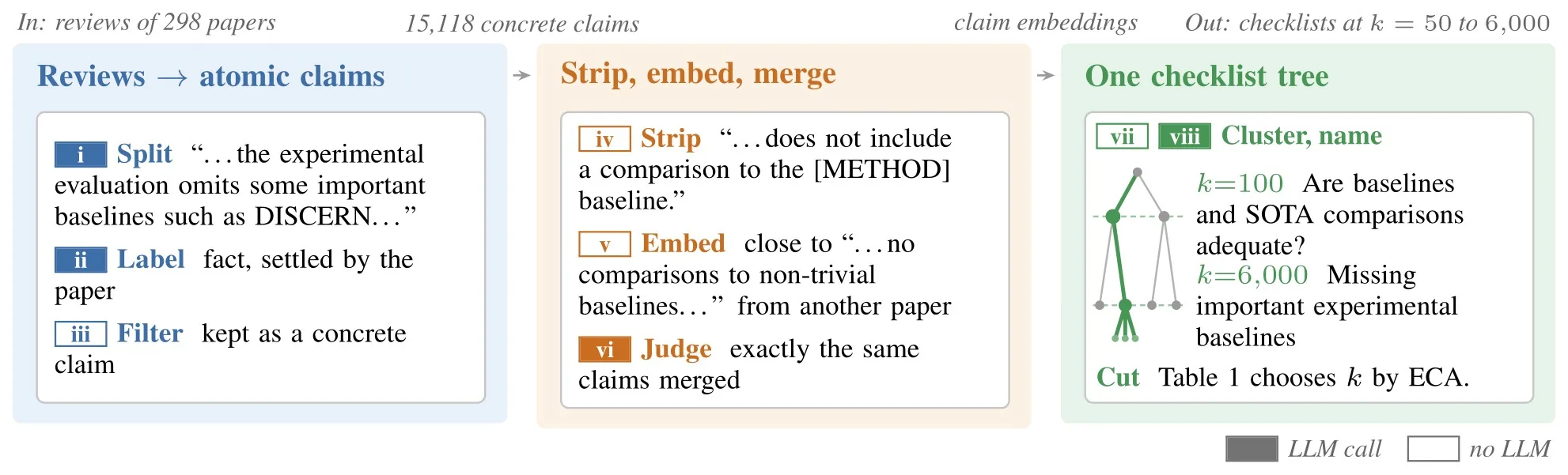
The pipeline. An LLM-assisted pipeline that turns a review corpus into a
tree of paper-checkable checklist items at every granularity.
The evidence. Lower committee error in simulated review on NeurIPS 2021
and ICLR 2022, and in a 20-person human ranking study.
58%less error for a three-reviewer committee on NeurIPS 2021
21%less error for the same committee size on ICLR 2022
k = 100checklist items: the highest ECA and the lowest error on both venues
0.48 → 0.22ranking error of human participants, without and with the checklist
The problem
Submissions keep surging, and review is getting noisier and less reliable. Decisions start
to look like a lottery, and a lottery rewards authors who simply try their
luck, which brings in even more papers.
The review death spiral (Liu and Tan, 2026, preprint). AI tools make papers cheaper to write,
so reviewers carry heavier loads and reviews get noisier; when outcomes are close to random,
submitting weak or spam papers pays off.
The NeurIPS 2021 experiment shows how noisy review already is: every paper was reviewed by
two independent committees. We also broke each review into atomic claims
and matched them across the two committees to see how much reviewers actually overlap.
23%of papers got different decisions from the two independent committees
34.3%of claims are also raised by the other committee
81%of issues are raised by only a single reviewer
18.2%of concrete criticisms are clearly refuted by the paper itself
So reviewers are noisy, and sometimes wrong. A shared checklist can fix part of this, but
it has a price.
A shared checklist
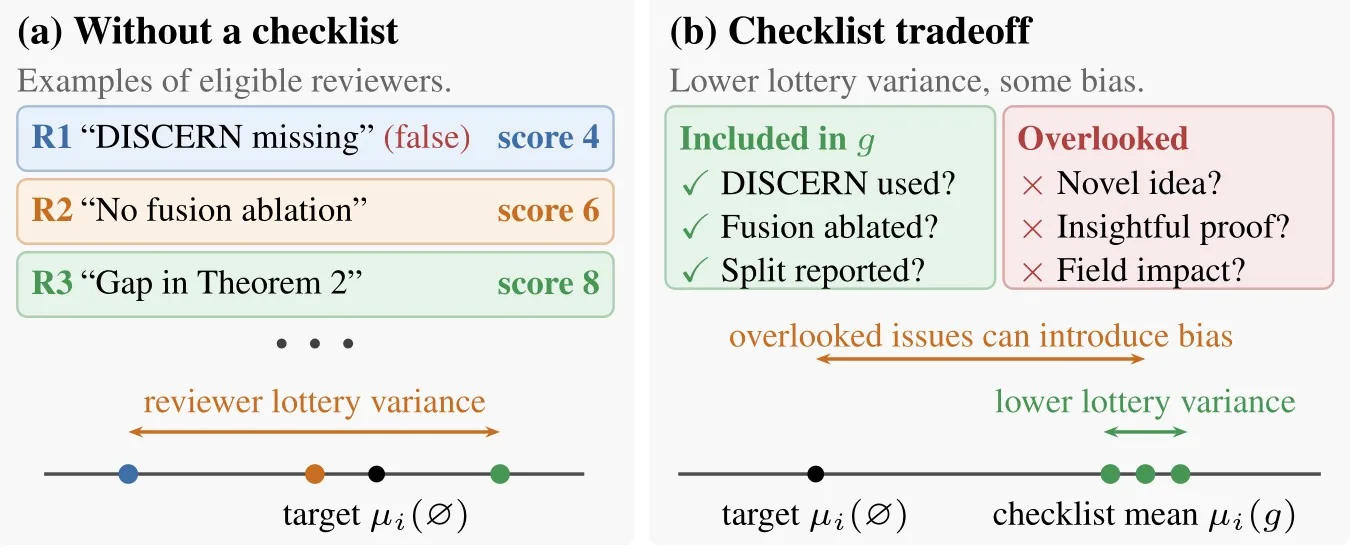
A shared, LLM-verifiable checklist can reduce variance, but it can also
introduce bias.
Every reviewer starts from the same checks, so scores agree more and checkable facts get
checked correctly. But a checklist also steers attention. Anything it leaves out may get less
weight from everyone at once, which moves the committee’s average away from the
target: the score the whole reviewer population would give,
μi(∅).
g: with a checklist; ∅: no checklist. Without a checklist there is no bias, so
the error is all variance, and it falls as 1/N for a committee of N reviewers.
Method
A checklist is a coarsening of the claims reviewers can make. The method
picks how coarse it should be with a proxy that past reviews can measure.
1
What is a checklist?
a coarsening of claims
g : Cver → {1, …, k}
Partitions paper-verifiable review claims into k shared checklist items. Choosing a checklist is choosing the granularity k.
2
The objective is out of reach
counterfactual scores
ming MSE(g) = Var(g) + (μ(g) − μ(∅))2
Unobservable on historical data: past reviewers only gave unaided scores Y(∅) and never saw candidate checklists g.
3
A proxy we can compute
observable from past reviews
maxg ECA(g) = Asame(g) − Adiff(g)
Expected correlated agreement: how much more often independent reviewers of the same paper raise the same checklist item than reviewers of different papers.
Choosing k by agreement
Past reviews cannot tell us how reviewers would have scored with a checklist they never saw,
so we cannot measure error directly. We measure agreement instead: how often
two reviewers of the same paper raise the same item (Asame), minus how
often reviewers of two different papers do (Adiff). Broad items inflate
both terms, narrow items shrink both, and the gap peaks in between. We prove that, under
stated conditions, the ECA-maximizing checklist approximates the one with the lowest error.
Same data as the table below. Broad items (left) inflate both agreement curves, narrow items (right) shrink
both, and the gap between them, ECA, peaks at k = 100 on both venues.
Items k
NeurIPS 2021
ICLR 2022
Asame
Adiff
ECA
Asame
Adiff
ECA
50
22.1
12.4
+9.8
38.9
27.2
+11.7
100
16.2
6.1
+10.2
28.8
15.9
+12.9
200
12.3
3.2
+9.0
21.7
9.2
+12.6
500
8.7
1.4
+7.3
15.8
4.2
+11.6
600
8.2
1.1
+7.1
14.9
3.5
+11.5
1,000
6.6
0.7
+5.9
13.1
2.3
+10.8
2,000
4.5
0.4
+4.2
10.9
1.2
+9.8
6,000
2.0
0.1
+1.8
8.1
0.4
+7.7
Agreement at eight cuts of the checklist tree (all values in %). Coarser cuts raise both
Asame and Adiff; ECA, their difference, peaks at
100 items on both venues (highlighted), and that is the checklist
reviewers see.
Building the checklist tree from historical reviews
The pipeline reads a historical review corpus and grows one tree of checklists.
Cutting the tree near the root gives a few broad items; cutting near the leaves gives
thousands of narrow ones. Each cut is a candidate value of k.
1
A review sentence
NeurIPS 2021
“Finally, the experimental evaluation omits some important baselines such as DISCERN, which was also evaluated on Atari.”
2
Split, filter LLM
15,118 claims from 298 papers
atomic claim the paper can settleThe paper’s experimental evaluation does not include a comparison to the DISCERN baseline.
3
Strip names
so papers can match
The paper’s experimental evaluation does not include a comparison to the [METHOD] baseline.
4
Embed, merge LLM
only exact repeats merge
this claim…does not include a comparison to the [METHOD] baseline.
nearby, another paper…does not include comparisons to non-trivial baseline algorithms…
5
Cluster, name LLM
one tree, many k
k = 100“Are baselines and SOTA comparisons adequate?”289 claims
k = 500“Does the paper compare against experimental baselines?”67 claims
k = 6,000“Missing important experimental baselines”12 claims
Show the paper’s original pipeline figure
An LLM splits each review into atomic claims and keeps only those the
paper itself can settle, so a model can later check them reliably.
Claims are stripped of paper-specific names, embedded, merged when identical, and
clustered into a tree whose nodes are named as questions to ask of a paper.
Results
Do the learned checklists reduce review error, in simulation and in a
human study?
A stable target to measure error against
To evaluate error we need the target μi(∅), but we cannot
aggregate infinitely many human reviewers. Instead we aggregate LLM-simulated
reviewers with no checklist until the aggregated score converges. For each of 30
held-out papers per venue (10 strong, 10 borderline, 10 weak), we draw one unaided reviewer for
each content branch of the tree at 50 items: 49 on NeurIPS and 47 on ICLR. Each reviews its
branch and scores the paper, and the average over all of them is the target.
committee mean − target, in score points
One unaided reviewer
±1.11
A committee of 4
±0.53
All 49 reviewers
±0.16
−10 = target+1
The range holding 80% of random committees of unaided reviewers, for the typical NeurIPS
paper. A single reviewer is typically within about 1.1 points of the target, four within about
0.53, and all 49 within about 0.16, the remaining uncertainty in the target itself. ICLR
numbers are similar (1.12, 0.59, 0.17).
A checklist cuts error
Three reviewers: variance and bias²
No checklist
0.27
Learned, k = 100
0.12
Official list
0.16
variancebias²
Show the paper’s original variance, bias and MSE figure
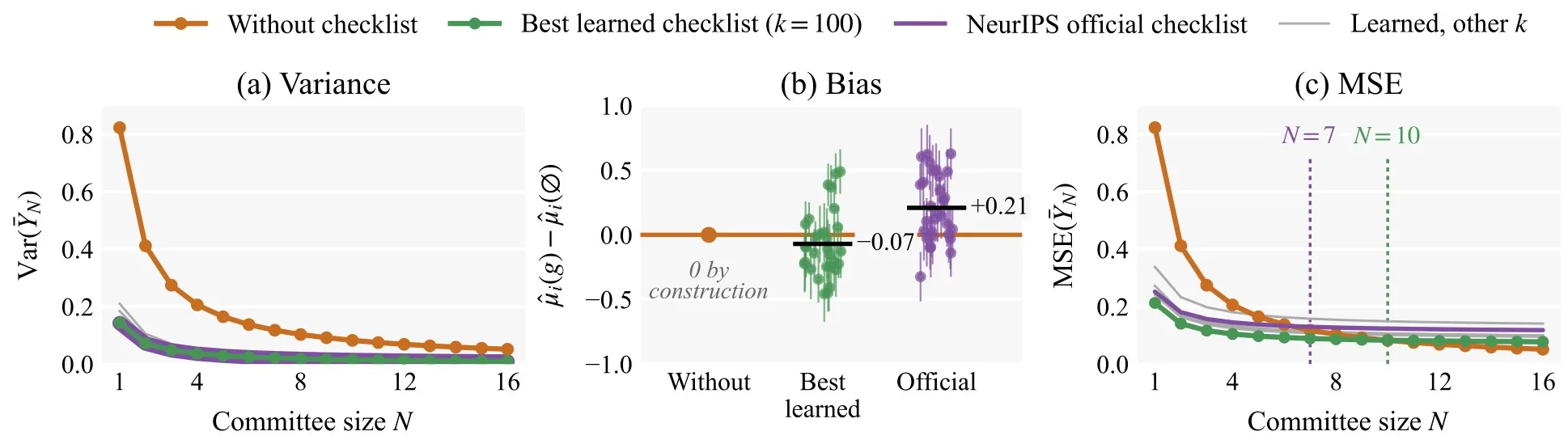
Committee error on NeurIPS 2021. The checklist cuts variance sharply and
adds only a small bias, so its total error stays below unaided review
until committees reach about ten reviewers.
With the 100-item checklist, a single reviewer’s error on NeurIPS drops from 0.82 to
0.21, and a committee of three has 58% lower error; a committee of four
halves its error (0.21 to 0.10). The official NeurIPS 2021 checklist lowers
variance just as much but adds more bias, leaving it about 0.04 worse at every committee size.
On ICLR, a single reviewer’s error drops from 0.84 to 0.34.
The k with the highest ECA has the lowest error
ECA is computed from past reviews only, so it needs no checklist to have been used. We check it
against the error of simulated four-reviewer committees, one point per checklist size. On both
venues the size with the highest ECA, k = 100, has the lowest error, and the size with
the lowest ECA, k = 2,000, has the highest (0.104 against 0.180 on NeurIPS, 0.205
against 0.287 on ICLR).
Each point is one checklist size k; the dashed line is a least-squares fit. Across
the five sizes ECA and error are strongly negatively correlated (r = −0.84 on
NeurIPS, −0.81 on ICLR). With five points per venue, r describes the pattern
and is not a significance test.
People also rank better with the checklist
In a human study, 20 participants each ranked two sets of three NeurIPS 2021
papers on the same topic, one with the k = 100 checklist and one without (topic and
condition counterbalanced across participants). The checklist was filled in by an LLM
beforehand. Error is the share of pairs ranked in the wrong NeurIPS order. It fell from
0.48 to 0.22 for one participant (−54%), and from 0.32 to 0.11 for a
committee of three (−66%).
Example set: neural network pruning · NeurIPS 2021 mean rating
Sparse Training via Boosting Pruning Plasticity with Neuroregeneration7.0
CHIP: CHannel Independence-based Pruning for Compact Neural Networks6.0
Efficient Neural Network Training via Forward and Backward Propagation Sparsification5.4
variancebias²no checklistchecklist
Ranking error is the share of pairs placed in the wrong NeurIPS order, split into variance and squared bias.
Both parts shrink with the checklist, for one participant and for a committee of three.
Takeaways
1
Formalize the checklist objective as a variance-bias tradeoff.Review error is variance plus bias², and a checklist moves both.
2
Propose ECA as a proxy objective for review error.On both venues, k = 100 has the highest ECA and the lowest error.
3
Formulate checklist design as coarsening the review claim space.k items, from broad to narrow: the single knob is the granularity.
What this does not claim
Only paper-checkable claims are on the list. Novelty and field impact stay off it, and that omission is the bias.
Simulated review uses LLM reviewers, each covering a narrow slice of concerns, on 30 papers per venue. The target is that simulated population, not a human meta-review.
The human study is a ranking task with a checklist an LLM filled in first; it does not test people writing reviews from a blank checklist.
Acceptance decisions are not measured. We do not claim a checklist should replace reviewers or change what a venue accepts.
Learning Checklists to Reduce Lottery Effects in Scientific Peer Review
Under review at ICLR 2027 · Oral and Best Paper Honorable Mention, NeurIPS 2026 Workshop on AI-Native Academia · xuanyouliu.com
Publication
This work is under review at ICLR 2027. The preprint is available on
arXiv
or as a direct PDF.
A workshop version, Learning Automated Checklists to Reduce Lottery Effects in Scientific
Peer Review, was accepted as an oral presentation at the NeurIPS 2026 Workshop on
AI-Native Academia: Authorship, Peer Review, and Conference Governance under AI,
where it received a Best Paper Honorable Mention.
Liu, X., Guo, Z., Hartline, J., & Hullman, J. (2026).
Learning Checklists to Reduce Lottery Effects in Scientific Peer Review.
arXiv preprint arXiv:2610.28666. Manuscript under review.
@misc{liu2026checklists,
  title={Learning Checklists to Reduce Lottery Effects in Scientific Peer Review},
  author={Liu, Xuanyou and Guo, Ziyang and Hartline, Jason and Hullman, Jessica},
  year={2026},
  eprint={2610.28666},
  archivePrefix={arXiv},
  primaryClass={cs.DL},
  note={Under review. Workshop version: Best Paper Honorable Mention, NeurIPS 2026 Workshop on AI-Native Academia}
}
Epistemic Decisions Lab
NeurIPS 2026 AI-Native Academia workshop
Learning Checklists to Reduce Lottery Effects in Scientific Peer Review
Xuanyou Liu, Ziyang Guo, Jason Hartline, Jessica Hullman
With surging paper submissions, noisy and wrong peer review leads to a “Death Spiral”
Noisy
of papers got different decisions from two independent committees
False criticism
18%
of reviewers’ claims can be refuted by the paper itself
Beygelzimer et al. 2023
Death Spiral
More & More Papers AI-fueled surgeOverload / Noise Review fatigueRandom LotterySpam Paid Off Even more papersReview death spiral
Liu et al. 2023
Venues already use expert-written checklists to reduce review noise
1
Examples
many venues now have one
Many venues now use an official checklist
NeurIPS Paper Checklist · ACL Rolling Review Responsible NLP Checklist and reviewer checklist · AAAI Reproducibility Checklist
2
Who writes it
experts
A list of points to watch for
Experts decide what reviewers should look at, giving everyone a shared basis for judging a paper.
3
Why it might help
a shared starting point
Every reviewer runs the same baseline checks
So scores depend less on which reviewers a paper happens to get.
A shared checklist helps with variance
but it introduces bias
A shared checklist reduces variance but introduces bias
Error of the committee mean
MSE=Variance+Bias2
A checklist helps when
Var(∅) − Var(g)variance removed
>
(μ(g) − μ(∅))2bias² added
g: with checklist · ∅: no checklist
A checklist is not always good
We need to formalize checklist generation to find a good one, responsibly
Learn the checklist from historical reviews
1
Not written by hand
learn it from data
Learn a checklist from historical data
Instead of experts writing the list by hand, let past reviews show what reviewers raise.
2
Our view
a checklist is a coarsening
A checklist is a coarsening of historical reviews
Specific past claims are grouped into broader, shared items. The coarsening level sets how broad they are.
3
Learning the checklist
find the right level
Find the level that minimizes review MSE
The right coarsening helps reviewers reach the lowest error.
Ideally, run a human experiment to find the optimal coarsening level
Human experiment
All possible reviewers give the target μi(∅)
Run reviews with different coarsening levels
MSE=Variance+Bias2
Choose the one with the smallest MSE
But this is impossible with human reviewers
So we use a proxy: Expected Correlated Agreement (ECA)
Compare reviewer agreement under different checklists. In theory, it finds the optimal coarsening level.
Pick the k with the biggest agreement gap (ECA), a proxy for error
Past reviewers never saw a checklist, so we cannot measure its error. We measure agreement.
Asame
Two reviewers of the same paper raise the same item.
Adiff
Two reviewers of different papers raise the same item.
ECA = Asame − Adiff
The gap peaks in the middle.
The peak
k = 100 on both venues: +10.2 NeurIPS, +12.9 ICLR.
Our pipeline
Build a checklist tree from historical reviews, then pick the level with ECA
Build a checklist tree from historical reviews
1
A review sentence
NeurIPS 2021
“FastNet is never compared with XGBoost, which is the standard strong baseline for tabular data.”
2
Split, filter LLM
15,118 claims kept
atomic claim the paper can settleThe paper does not compare FastNet with XGBoost.
3
Strip names
so papers can match
The paper does not compare [METHOD] with XGBoost.
4
Embed, merge LLM
only exact repeats merge
this claim…does not compare [METHOD] with XGBoost.
nearby, another paper…Random Forest is not included as a baseline for [METHOD].
5
Cluster, name LLM
one tree, many k
k = 100“Is the method compared against baselines?”
k = 200“Are strong tabular-data baselines included?”
k = 6,000“No comparison to XGBoost”
Evaluation
Do the learned checklists reduce review error in simulation and human studies?
Simulate a stable ground truth to evaluate the error
30 held-out papers per venue. Every reviewer is an LLM agent.
Review error of the committee mean
MSEi(g) = E[(Yi(g) − μi(∅))2]
= Var(Yi(g)) + (μi(g) − μi(∅))2
To evaluate error, we need the target μi(∅).
We cannot aggregate infinitely many human reviewers.
We aggregate LLM-simulated reviewers with no checklist, until the aggregated score converges.
A three-reviewer committee has 58% lower error with a checklist
Simulated review on 30 held-out NeurIPS 2021 papers.
The k with the highest ECA has the lowest error
Each point is one checklist size k. Error is from simulated review with N = 4 reviewers.
NeurIPS 2021r = −0.84 (n = 5 sizes)
ICLR 2022r = −0.81 (n = 5 sizes)
People also rank better with the checklist
20 participants. Checklists filled in by an LLM.
Task
Rank 3 papers on the same topic with/without a checklist.
Example: pruningNeurIPS score
Sparse Training via Boosting…7.0
CHIP: CHannel Independence…6.0
Efficient Neural Network…5.0
Error: pairs ranked against the NeurIPS order.
Learning Checklists to Reduce Lottery Effects in Scientific Peer Review
1
Formalize the checklist objective in terms of the variance-bias tradeoff
variance + bias²a checklist moves both
2
Propose ECA as a proxy objective for review error
k = 100highest ECA, lowest error
3
Formulate checklist design as coarsening the review claim space
k itemsfrom broad to narrow
Xuanyou Liu
Ziyang GuoOn the job market
Jason Hartline
Jessica Hullman
Backup · agreement at eight cuts
ECA peaks at 100 items on both venues
Items k
NeurIPS 2021
ICLR 2022
Asame
Adiff
ECA
Asame
Adiff
ECA
50
22.1
12.4
+9.8
38.9
27.2
+11.7
100
16.2
6.1
+10.2
28.8
15.9
+12.9
200
12.3
3.2
+9.0
21.7
9.2
+12.6
500
8.7
1.4
+7.3
15.8
4.2
+11.6
600
8.2
1.1
+7.1
14.9
3.5
+11.5
1,000
6.6
0.7
+5.9
13.1
2.3
+10.8
2,000
4.5
0.4
+4.2
10.9
1.2
+9.8
6,000
2.0
0.1
+1.8
8.1
0.4
+7.7
All values are percents. The highlighted row is the checklist reviewers see.
Backup · limits
What this does not claim
What is on the listPaper-checkable claims
Novelty and field impact stay off the list. That omission is the bias.
Simulated review30 papers per venue
LLM reviewers, each covering a narrow slice. The target is that population, not a human meta-review.
Human studyRanking, prefilled
20 people ranked papers. The checklist was filled in by an LLM first.
Not measuredAcceptance decisions
We do not claim the checklist should replace reviewers, or that it changes what a venue accepts.







 Epistemic