





Infer the body from the head
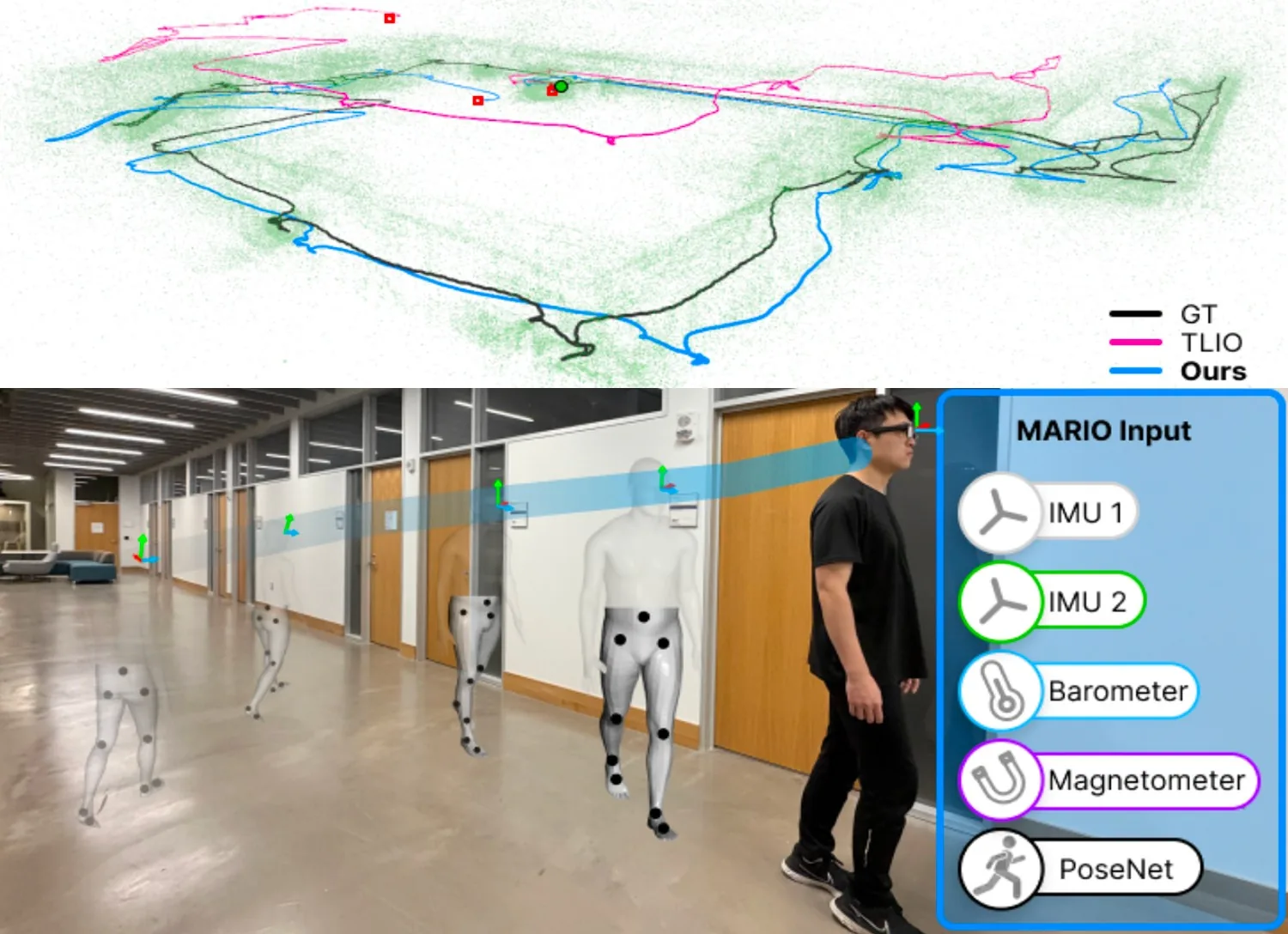
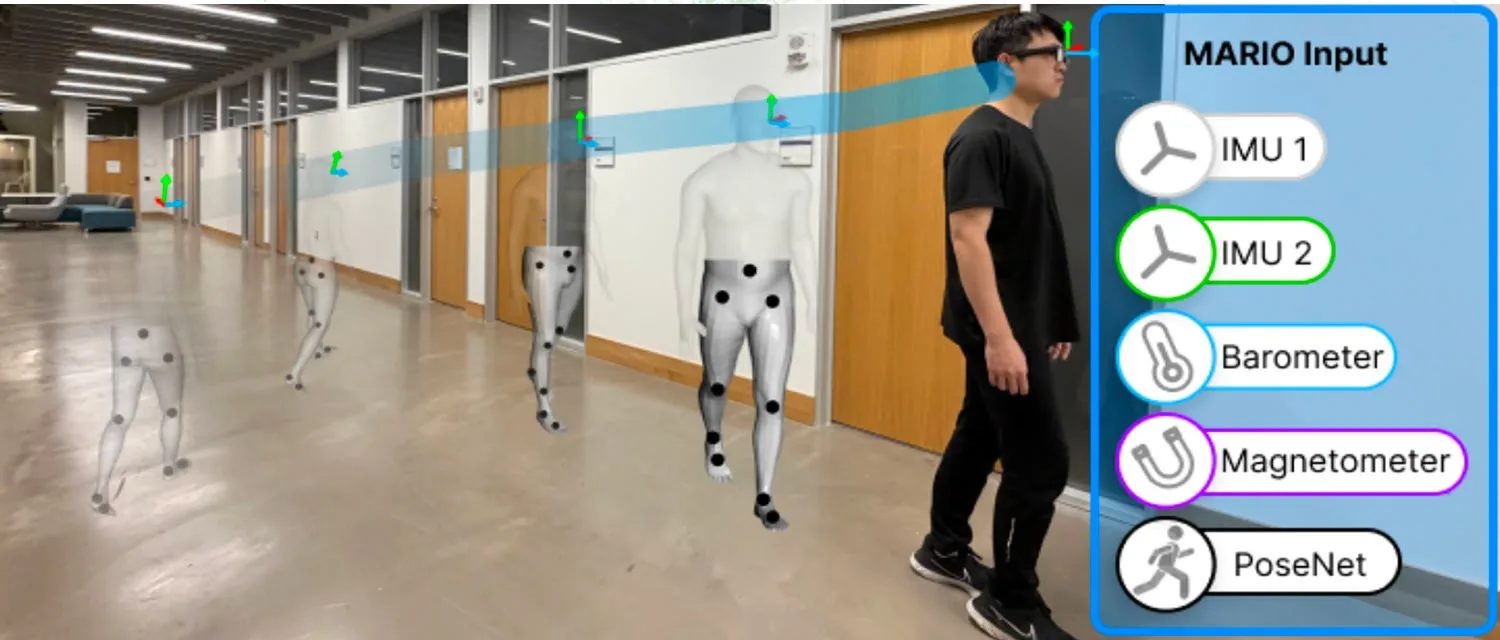
A model reads head motion and predicts how the pelvis and legs are moving, which keeps estimates consistent with human walking.
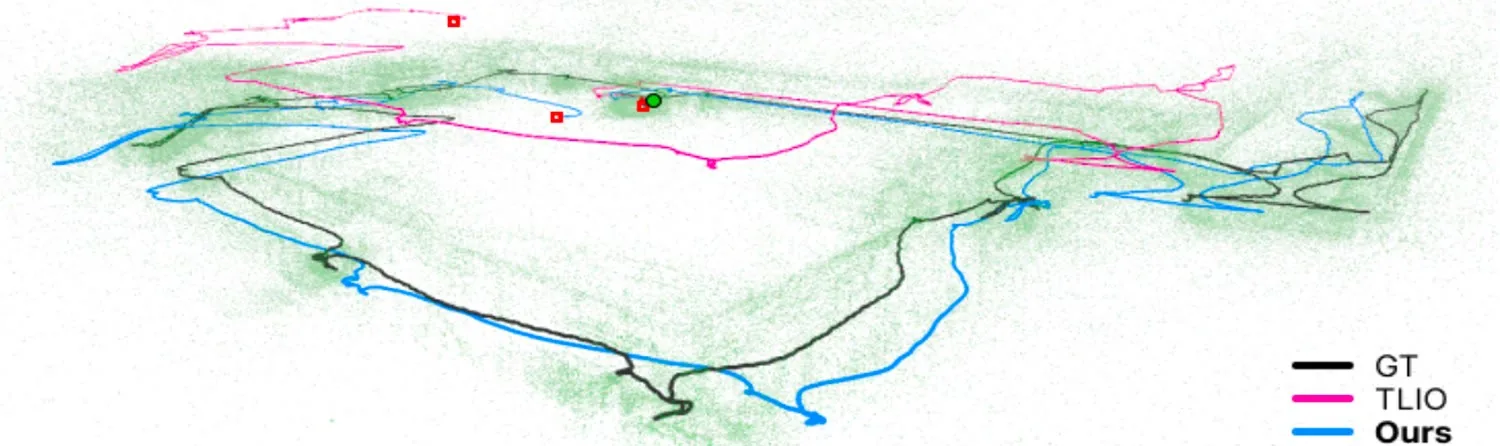
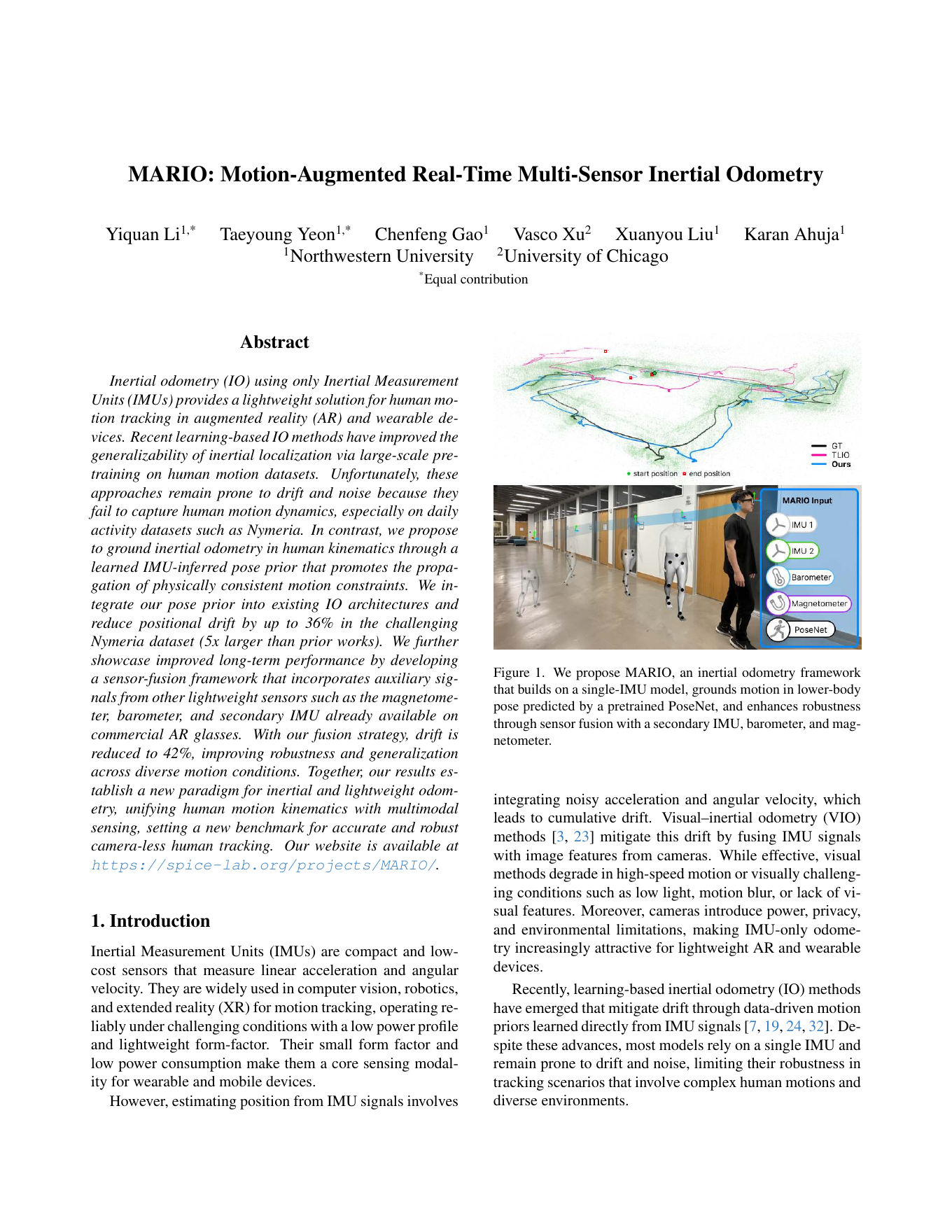
Inertial odometry using only IMUs offers a lightweight approach to human motion tracking for augmented reality and wearables, but learning-based methods often drift because they lack explicit models of human motion dynamics. We propose MARIO, which grounds inertial odometry in human kinematics through a learned pose prior inferred from IMU data, promoting physically consistent motion during state propagation. We further develop a sensor-fusion framework that incorporates auxiliary signals from lightweight sensors already available on commercial AR glasses, including magnetometers, barometers, and secondary IMUs. Evaluated on a large-scale motion dataset, MARIO substantially reduces positional drift compared with strong IO baselines and improves robustness across diverse motion conditions, pointing toward lightweight, camera-free human tracking that unifies kinematic priors with multimodal sensing.
MARIO has two components that attach to an existing inertial odometry model: a pose prior (PoseNet) and a multi-sensor fusion module. We integrated both into four architectures: TLIO, AirIO, RoNIN-LSTM and EqNIO.
PoseNet. A network takes linear acceleration, angular velocity and orientation from a single head-mounted IMU and predicts nine joint angles of the pelvis and lower limbs in SMPL format, using a 6D rotation representation. Arm and hand motion is excluded because it is underconstrained when estimated from a head-mounted IMU. The predicted pose serves as a kinematic prior for the odometry model.
Multi-sensor fusion. The second IMU, barometer and magnetometer streams are resampled to 200 Hz, encoded, and concatenated with the pose estimate from the frozen PoseNet. The fused representation is passed to an existing inertial odometry model, which predicts the trajectory.
The auxiliary sensors provide different cues:
We trained and evaluated on Nymeria, which comprises 1,200 sequences of 15 to 20 minutes from 264 subjects in 50 indoor and outdoor environments, about 300 hours and 400 km in total. Project Aria glasses record two IMUs, a magnetometer and a barometer; ground-truth trajectories come from the Project Aria MPS system, and an Xsens suit provides the full-body pose that supervises PoseNet.
Nymeria is split 80/10/10 into training, validation and test sets. To test generalisation, models pretrained on Nymeria were also evaluated without fine-tuning on Aria Everyday Activities (143 sessions in five indoor environments, 7.3 hours), and baseline comparisons follow the original split of the TLIO dataset. Metrics are the absolute trajectory error (ATE), the relative translational error over 1 s and 5 s windows (RTE), and a segment-wise drift rate (Drift).
The table lists results on the Nymeria test split for four architectures, each as the base model, with the pose prior (+Pose), and with the pose prior and all three sensors (+All).
| Model | ATE (m) | Drift (%) | ||||
|---|---|---|---|---|---|---|
| Base | +Pose | +All | Base | +Pose | +All | |
| AirIO | 6.85 | 5.22 | 4.64 | 3.56 | 2.35 | 2.16 |
| TLIO | 10.19 | 7.97 | 5.73 | 6.46 | 4.94 | 3.64 |
| EqNIO | 7.63 | 7.65 | 4.52 | 3.93 | 4.30 | 2.40 |
| RoNIN-LSTM | 9.10 | 6.83 | 5.89 | 6.22 | 3.99 | 3.61 |
The pose prior alone lowered ATE for AirIO, TLIO and RoNIN-LSTM, but not for EqNIO (7.63 m to 7.65 m). Adding the three sensors lowered ATE further for all four models.
On Aria Everyday Activities, with models pretrained on Nymeria and no fine-tuning, the full system lowered ATE for all four architectures (for example from 1.51 m to 1.02 m for TLIO), and the pose prior alone cut the drift of AirIO from 11.38% to 5.32%, a reduction of 53% (paper Table 2).
With the pose prior and all sensors, AirIO runs at 315 FPS on an NVIDIA A40 GPU (133.6 M FLOPs per inference).
This is research from the SPICE Lab at Northwestern University by:
This work appears at CVPR 2026 (Findings). The published version is available via its DOI, and the authors’ print is available here (PDF).
@inproceedings{li2026mario,
  title={MARIO: Motion-Augmented Real-Time Multi-Sensor Inertial Odometry},
  author={Li, Yiquan and Yeon, Taeyoung and Gao, Chenfeng and Xu, Vasco and Liu, Xuanyou and Ahuja, Karan},
  booktitle={2026 IEEE/CVF Conference on Computer Vision and Pattern Recognition - Findings Track (CVPRF)},
  address={Denver, CO, USA},
  pages={3460--3469},
  year={2026},
  doi={10.1109/CVPRF71909.2026.00336}
}